For much of the past half century, students graduated from university with a strangely thin record of what they had actually learned. After three or four years of study, thousands of hours of effort, and countless acts of growth, what remained was often little more than a certificate, a transcript, and a final classification. The degree signalled that a student had completed a programme; it revealed very little about what they could actually do.
By the late 2020’s, this had become increasingly difficult to defend. Employers wanted richer evidence of capability and students wanted recognition for more than exam performance. Universities were also being pressed to demonstrate value for money and as artificial intelligence began to transform work, the limits of the traditional degree certificate became harder to ignore. A single grade could not capture a student’s creativity, teamwork, problem-solving, digital fluency, ethical judgement, resilience, or professional identity. Nor could it preserve the artefacts of their learning: projects, presentations, simulations, prototypes, placements, reflective journals, design work, and collaborative outputs. Much of that evidence simply disappeared at the end of each module.
This was the context in which universities began, slowly at first, to adopt online learning portfolios.
Why universities moved toward online portfolios
The first wave of adoption came from a mixture of frustration and opportunity. On the one hand, there was a growing recognition that traditional assessment systems were too narrow. Essays and exams produced marks, but often ignored the learning process. Students could complete an entire programme and still struggle to show an employer what they had made, improved, designed, solved, or contributed. The degree was acting as a blunt proxy for a far richer educational journey.
On the other hand, digital platforms were becoming more capable. Early e-portfolio systems allowed students to upload work and curate examples of achievement. What began as a repository gradually evolved into something much more powerful: a verified, searchable, portable, and increasingly intelligent account of a learner’s abilities.
At first, universities adopted portfolios to solve practical problems: helping students evidence employability, supporting placement-based courses, improving reflection and professional development, linking learning across modules and showcasing final-year projects. But over time, the logic deepened. Portfolios were not just a career add-on. They were becoming a better representation of learning itself.
How the portfolio model evolved
The earliest online portfolios in the 2010s and 2020s were often quite clunky. Students uploaded files, wrote reflections, and occasionally shared pages with tutors or employers. Many were underused because they were treated as optional extras rather than central learning tools.
The breakthrough came when universities began integrating portfolios directly into the learning experience. Instead of sitting at the edge of the curriculum, portfolios became the place where students: gathered evidence of learning, mapped progress against competencies, received feedback, linked modules together, built professional identities and shared work with external audiences.
By the 2030s, several developments accelerated adoption:
- AI-assisted curation – AI systems helped students organise work, identify themes, summarise strengths, tag skills, and suggest which evidence best demonstrated particular competencies.
- Verified skills frameworks – rather than being mere personal scrapbooks, portfolios became linked to validated skill frameworks, allowing institutions and employers to see evidence behind claims.
- Multimedia and simulation evidence – portfolios expanded beyond documents to include: videos, code repositories, design prototypes, virtual simulations, placement logs, peer feedback, oral defences and live project dashboards.
- Employer integration – employers began to access selected parts of portfolios directly, using them to evaluate candidates more intelligently than through CVs and degree classifications alone.
- Lifelong portability – students no longer lost access after graduation. Portfolios followed them into employment and were updated across the lifespan.
By the 2040s, the most advanced universities had moved from “e-portfolios” to dynamic learning identity platforms – living records of knowledge, capability, reputation, and growth.
What benefits did online portfolios bring?
The benefits turned out to be substantial.
For students –Portfolios helped students: make their learning visible, connect theory to practice, present richer evidence to employers, recognise growth across time, reflect more meaningfully on strengths and weaknesses and build confidence and professional identity. Students who once left university with only a certificate now graduated with a curated body of evidence showing what they had actually learned and achieved.
For employers –Employers benefited from seeing: examples of real work, of development, collaboration history, evidence of initiative, communication style and the practical application of knowledge. In many sectors, portfolios proved more useful than transcripts because they reduced guesswork.
For universities – Universities gained: better evidence of student learning, improved links between curriculum and employability, more authentic assessment possibilities, stronger alumni relationships, clearer insight into graduate outcomes and new opportunities to support lifelong learning and CPD.
How online portfolios changed assessment
This was perhaps the most important effect of all. Once universities had a platform capable of storing and organising evidence of learning over time, the logic of assessment began to shift. Traditional assessment had often been: discrete, module-based, one-off, heavily grade-focused and disconnected from future use. Portfolio-based assessment gradually pushed universities toward models that were: longitudinal, integrative, evidence-rich, developmental, authentic and outward facing.
This changed assessment in several important ways.
- Students were increasingly assessed through: projects, design challenges, public outputs, placements, simulations, performances, client briefs and collaborative problem solving
- Instead of one final exam or one final essay, students built evidence over time.
- Tutors could see how a learner’s work improved across months or years, not just how they performed on one occasion.
- Reflection stopped being an optional afterthought and became a central part of academic development.
- The portfolio did not eliminate grading altogether, but it weakened the idea that a single mark should dominate the interpretation of a student’s learning.
- Many universities began mapping portfolio evidence against broader capabilities such as: communication, collaboration, ethical judgement, digital literacy, creativity, leadership and systems thinking. In this sense, the rise of online portfolios contributed directly to the wider shift away from the certificate-and-grade model of higher education.
What a portfolio platform looked like in 2050
By 2050, a leading portfolio platform looked less like a file store and more like a learning intelligence dashboard.
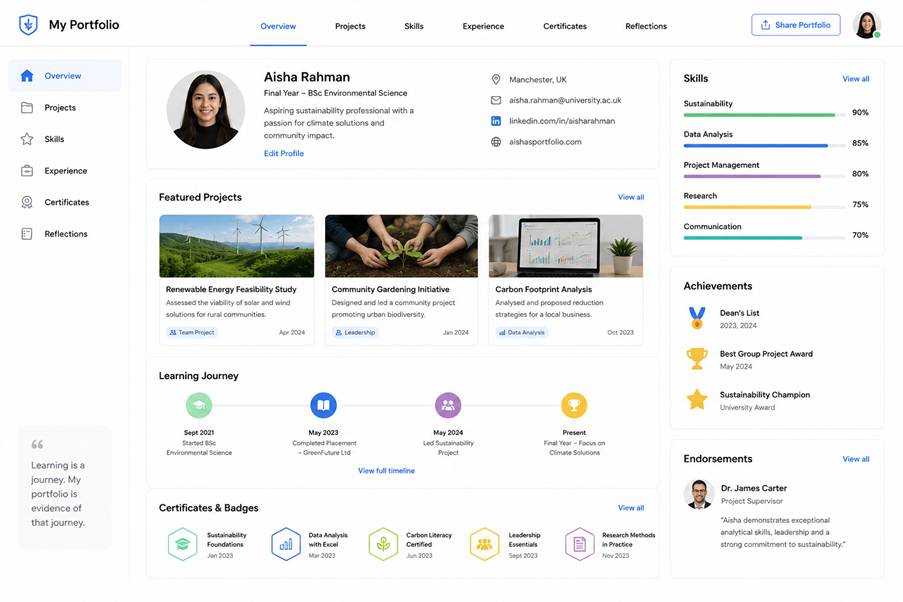
The image above illustrates a plausible 2050 platform. Key features include:
- Profile and identity layer: a professional-facing overview of the learner, their interests, and verified status
- Verified skills dashboard: a visual representation of key competencies, skill growth, and reputation indicators
- Project showcase: rich evidence from real assignments, placements, research, simulations, and collaborative work
- AI feedback panel: summarised strengths, development needs, and future recommendations
- Micro-credentials area: badges, certificates, and short-course completions linked to evidence
- Employer endorsements: validated comments from supervisors, partners, and collaborators
- Career pathways panel: likely career routes based on demonstrated strengths
- Timeline of achievements: a dynamic record of milestones and progression over time
- Competency map: a networked view of how learning connects across domains
In short, the portfolio had become part transcript, part CV, part learning analytics system, part reflective journal, and part skills passport.
A final thought from 2050
The old degree certificate was never entirely useless. It offered a simple, recognisable signal. But it was always a very thin representation of a much richer educational story. The online portfolio changed that. It didn’t just help students showcase what they had done. It changed how universities thought about learning itself – from something briefly examined and then archived, to something continuously evidenced, visualised, shared, and developed over time.
 HE2050