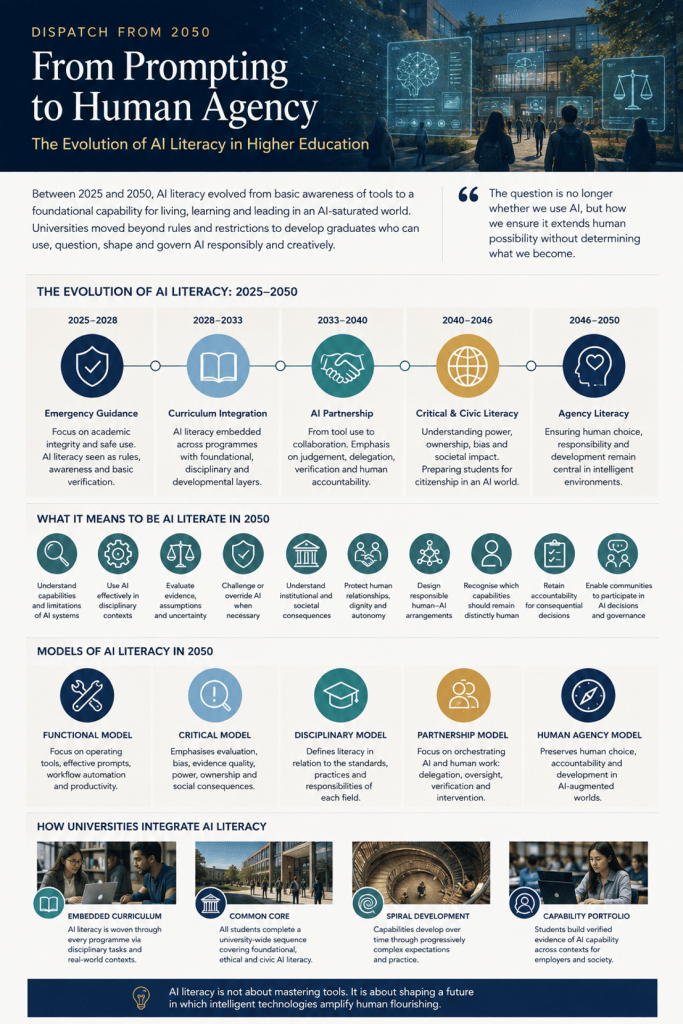
The development of AI literacy between 2025 and 2050 can be divided into five broad phases.
The era of emergency guidance (2025-2028)
The first phase was dominated by institutional anxiety. Generative AI had entered universities faster than policy could respond. Students were already using it to brainstorm, explain concepts, summarise readings, generate code, translate text, structure essays, and improve written work. Academic staff used the same systems to design teaching materials, prepare feedback, create assessment questions, and manage administrative workloads. Yet universities had no shared understanding of what counted as legitimate use.
Initial responses focused heavily on academic integrity. Institutions published traffic-light systems distinguishing acceptable, conditional, and prohibited practices. Students were told to acknowledge AI use, verify outputs, protect confidential information, and remain responsible for submitted work. AI literacy during this period was largely defensive. It was designed to help students avoid misconduct and help staff preserve existing assessment arrangements.
The most common learning outcomes were:
- understand that AI can produce inaccurate information
- recognise bias and hallucination
- use prompts more effectively
- acknowledge AI assistance
- follow institutional rules
- protect personal and confidential data
These were valuable foundations, but they treated AI literacy as a form of safe tool use rather than a fundamental graduate capability. The weaknesses of this approach soon became apparent. Rules varied between modules. One lecturer encouraged AI experimentation while another prohibited it. Students received generic advice that did not explain how AI should be used differently in nursing, engineering, history, education, law, or art. Universities gradually realised that there could be no single universal rule for responsible AI use. Literacy had to be contextual.
AI literacy enters the curriculum (2028-2033)
The second phase began when universities stopped relying on optional training. By the late 2020s, it was clear that short workshops attended mainly by already confident students would not produce equitable capability. Institutions began embedding AI literacy across programmes rather than offering it as a separate extracurricular activity.
Most universities adopted a three-layer model. The first layer was a common institutional foundation. Every student learned about:
- how generative AI systems work at a basic level
- the limitations of probabilistic outputs
- data provenance and privacy
- bias, misinformation, and synthetic media
- responsible attribution
- human accountability
- the environmental and social costs of AI
The second layer was disciplinary. Students explored how AI affected knowledge and practice in their own fields.
The third layer was developmental. Expectations increased as students progressed. First-year students learned to use and question AI. Intermediate students compared systems, evaluated evidence, and documented their processes. Advanced students designed AI-supported workflows, audited outputs, and defended consequential decisions.
This period also saw the emergence of AI literacy assessment. Students were no longer merely told to be critical; they had to demonstrate it. Typical assessments included:
- identifying errors in AI-generated explanations
- comparing outputs produced by different models
- documenting and defending an AI-assisted research process
- revising biased or unsafe generated material
- completing a task both with and without AI
- explaining when human judgement should override automation
The most successful universities resisted the temptation to create a single generic “AI skills module” and declare the problem solved. They recognised that AI literacy developed through repeated encounters across the curriculum.
As Professor Rina Shah, who led one of the earliest university-wide programmes, later recalled:
“We discovered that students did not become AI literate by attending a lecture about AI. They became literate by repeatedly making decisions about its use, seeing it fail, defending their choices, and understanding how those choices changed within different disciplines.”
From AI use to AI partnership (2033-2040)
The third phase began as AI systems became persistent learning and workplace companions. By the mid-2030s, most students had access to personalised AI tutors, research assistants, simulation partners, and career advisers. The important distinction was no longer between students who used AI and those who did not. Almost everyone used it. The relevant question became whether they used it well. Universities expanded AI literacy beyond prompting and verification. Students were expected to understand the division of labour between humans and machines.
They learned to ask:
- Which parts of this task should be delegated?
- Which decisions require human responsibility?
- What capabilities may weaken through over-reliance?
- How should an AI recommendation be challenged?
- What evidence would justify overriding the system?
- How should uncertainty be communicated?
- Who bears responsibility when a joint human–AI decision causes harm?
This marked the emergence of AI partnership literacy. Students were assessed on their ability to orchestrate multiple systems, compare competing recommendations, intervene when automation failed, and preserve independent judgement. Professional programmes increasingly treated this as equivalent to learning how to work with human colleagues.
Universities also began to teach cognitive independence. Research showed that students could produce higher-quality work with AI while understanding less, remembering less, and becoming less willing to struggle with difficult problems. AI literacy therefore acquired a metacognitive dimension. Students learned to monitor:
- when AI improved their thinking
- when it merely improved the appearance of their work
- when assistance became substitution
- which intellectual capabilities required unaided practice
- how to reconstruct an argument without technological support
This was a decisive shift. AI literacy no longer meant maximum use. It meant proportionate, conscious, and purposeful use.
Critical, civic, and political AI literacy (2040–2046)
The fourth phase emerged as AI systems became deeply embedded in public institutions, media, employment, finance, education, healthcare, and government. Universities concluded that functional competence was insufficient. A graduate might be highly capable at working with AI while having little understanding of who owned the systems, whose data trained them, which interests shaped their outputs, or how they redistributed power.
AI literacy therefore expanded into critical AI literacy. Students studied:
- ownership and concentration within AI markets
- the political economy of data
- automated surveillance
- labour displacement and occupational redesign
- model bias and representational harm
- platform power
- environmental resource use
- the governance of synthetic media
- inequalities in access to computational infrastructure
- the relationship between AI and democratic authority
This was not simply ethics training added to a technical curriculum. It required students to understand AI as a social and institutional system.
Students learned that AI systems embodied choices about classification, value, risk, and legitimacy. They explored whose knowledge was represented, whose language was marginalised, and whose behaviour became visible to automated systems.
By the mid-2040s, many universities also introduced civic AI literacy as a universal graduate requirement. Students had to understand how AI influenced elections, public services, policing, welfare, employment, and access to information. The aim was not simply to prepare people for work. It was to prepare citizens to participate meaningfully in societies governed partly through algorithms.
Professor Malik Owens, President of the Global Civic University Network, described the change in 2045:
“We had spent a decade teaching people how to operate AI systems. We then realised that democracy depended on their ability to question who operated those systems, for what purpose, and with what authority.”
AI literacy becomes agency literacy (2046-2050)
By the late 2040s, the most influential universities stopped using AI literacy as a single undifferentiated term. AI had become too embedded in everyday activity for literacy to be defined merely by knowledge of particular tools. Models changed constantly. Interfaces became largely invisible. Many systems anticipated needs and acted before users issued explicit instructions.
Universities therefore reframed AI literacy as agency literacy: the capacity to preserve meaningful human choice, responsibility, and development within intelligent environments. The central question became:
Can a person understand and influence the systems shaping their decisions, opportunities, knowledge, and behaviour?
This conception placed human purposes before technological proficiency.
A genuinely AI-literate graduate in 2050 is expected to be able to:
- understand the capabilities and limitations of AI systems
- use them effectively within disciplinary and professional contexts
- evaluate their evidence, assumptions, and uncertainties
- challenge or override them when necessary
- understand their institutional and political consequences
- protect human relationships, dignity, and autonomy
- design responsible human–AI arrangements
- recognise which capabilities should remain distinctly human
- retain accountability for consequential decisions
- help communities participate in decisions about AI deployment
AI literacy is therefore no longer a subset of digital competence. It is part technical knowledge, part knowledge evaluation, part ethics, part political education, and part personal development.
The continuing tensions
The development of AI literacy did not remove controversy. Some critics argued that universities became too responsive to technology companies and trained students to accommodate systems that should have been resisted. Others worried that AI literacy curricula became outdated almost as soon as they were approved. There were persistent inequalities. Wealthier universities provided students with advanced systems, simulations, and expert support, while less well-funded institutions sometimes relied on generic commercial training. There was also disagreement over whether universities should certify AI competence when the long-term cognitive effects of continuous assistance remained uncertain.
Most importantly, institutions struggled to balance AI-enabled performance with intellectual independence. Students could produce extraordinary work with AI. But universities had to ensure they could still read deeply, think slowly, tolerate uncertainty, construct arguments, remember essential knowledge, and form judgements without immediate machine mediation. The strongest AI literacy models therefore included the right and capacity to disengage. They taught that refusal, restraint, and unaided thinking could sometimes represent higher levels of literacy than seamless use.
What these developments revealed
The history of AI literacy from 2025 to 2050 is the history of a concept repeatedly outgrowing its original definition. It began with prompting and quickly expanded into verification. It then developed into disciplinary competence and would later incorporate ethics, power, and citizenship. Eventually it became a question of human agency.
Universities that treated AI literacy as a short technical course found themselves continually behind. Those that embedded it across disciplines, assessments, professional practice, and civic education created graduates capable of more than operating the tools of their age. They created graduates capable of questioning, shaping, and sometimes resisting them.
The defining AI-literacy question in 2025 was:
How do we use these tools properly?
By 2050, it has become:
How do we ensure that intelligent systems extend human possibility without quietly determining what human beings become?
That is why AI literacy now sits at the centre of the university curriculum. It is now understood as the capacity to live, learn, work, and exercise judgement in environments where artificial intelligence is continuously present. It includes the ability to use AI, but it also includes knowing when not to use it, how to challenge it, how to work alongside it, how to understand its social consequences, and how to retain meaningful human agency.


Leave a comment